
Esoteric & Based Memo #23
The Twenty third
1. A Book
African Meditations, by Felwine Sarr, 2012 (translated from French by Drew S. Burk)
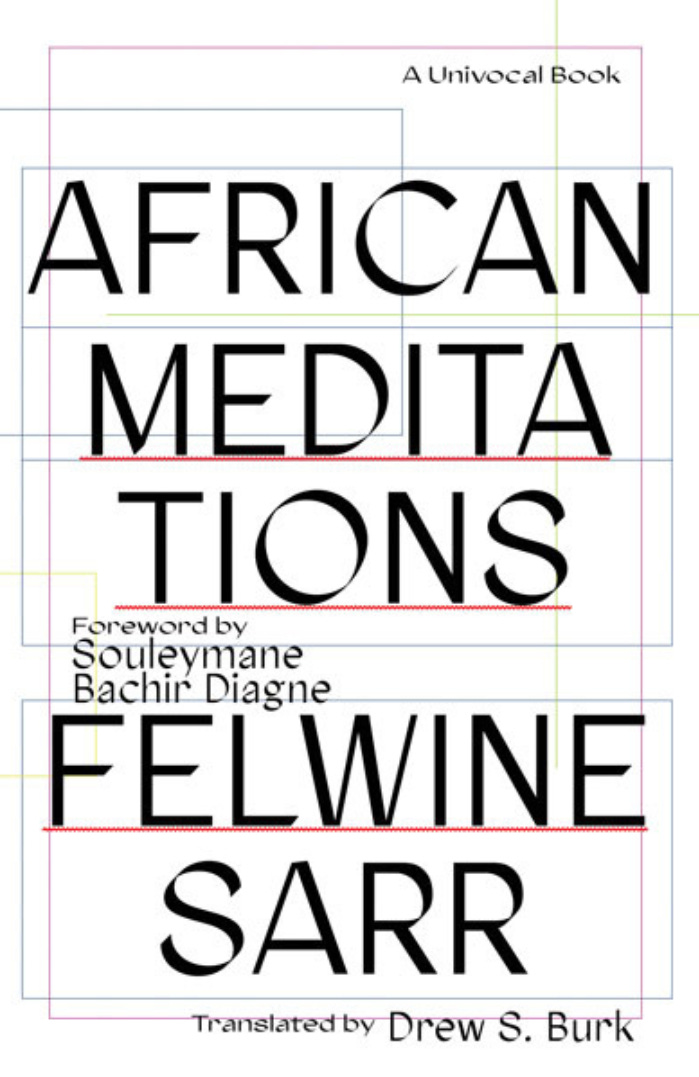
I found this book by chance when I was visiting my home town of Cape Town earlier this year, floating around one of my favourite bookstores, Clarke’s, slightly hungover and deeply at peace. I thank all of the Gods that I did - what an exquisite little gem of a book, steeped in wisdom, sprinkled with humour. The story follows a young philosopher and creative writer who seeks to establish himself as a teacher upon his return to Senegal, his homeland, after years of studying abroad.
I left South Africa at twenty-three to pursue a post-grad in California. I cannot draw any comparison between myself (mediocre) and the author Felwine Sarr (brilliant), other than the shared angst that comes with having chosen to leave home in Africa for a country in the West. Spending the first twenty-three years of my life in South Africa remains the greatest gift of my life; growing up there shaped so much of how I view the world, and I often dream of moving back. But seven years have passed, and the South Africa I left no longer exists. The version of me that left South Africa no longer exists. Cape Town, since the birth of our democracy in 1995, has long been a playground for the ultra-rich and a neoliberal hell for the many. This stark reality has been exacerbated by the TikTokification of it all (a global tragedy not exclusive to South Africa).
African Meditations exists as a blurry mirror, a soothing balm and a harsh reminder of the complicated yet mostly beautiful feelings I share with Sarr regarding home; leaving home, returning home and all the different versions of oneself that exist within and in between those places. The book is a seamless blend of autobiography, journal entries, and fiction; aphorisms and brief narrative sketches; humour and Zen reflections, all while traversing a semi-surrealistic landscape. As the author reacclimates to his native country after a life in France, we get vulnerable glimpses, divine and mundane, into his Zen journey to reacclimate to his homeland whilst navigating academia, an ode to experiencing joy amid the struggles of life in Senegal.
“When the joy that accompanies love only makes itself heard in brief intermittent moments, and all that remains is remorse, guilt, and the fear of breaking from one’s habits, it is time to raise oneself up and immigrate to another region in this vast territory that is Love.”
“The patience that these ‘inconveniences’ impose on us, us moderns, also invites us to reflect and constantly revisit the notion of necessity. The forecasting and cautious frugality in which we have become accustomed to these water shortages serves as a remedy against the wasting of such a vital resource in these maddening times.”
“The chief of the locale, the local bodhisattva, with a mischievous gaze and welcoming smile, knew how to make of it a haven of peace. He constructed it in such a way so as to ensure that everything didn’t function too well. So as to ensure that those who were a bit more elitist, aggressive of spirit, or too hip didn’t want to settle there.”
“We are not always useful only where we feel at home, for this would be to reduce our potentialities to our tastes or preferences; truly opening one’s arms out wide is what allows for any (self) discipline.”
“… from anywhere on this great earth, we can raise our gaze up to the heavens.”
“The Upanishads teach: Know thyself-thyself. But we can only know ourselves through a relation to the other.”
“The death of someone close to us opens up a wound in our sensibility. The fundamental fragility of things reappears to us. The essential vibration and trembling of life becomes at once all the more vibrant. This sudden state of immense receptivity becomes an exhaustible resource for learning.”
“Little by little, through prayer, I remove the prayer, in order to remain alone with presence.”
“To traverse evil without falling for the notion that one is the incarnation of good.”
“An immensity of beauty surrounds us. To avoid burning ourselves, a veil, which poets sometimes pierce, separates us from such beauty.”
2. An Artwork
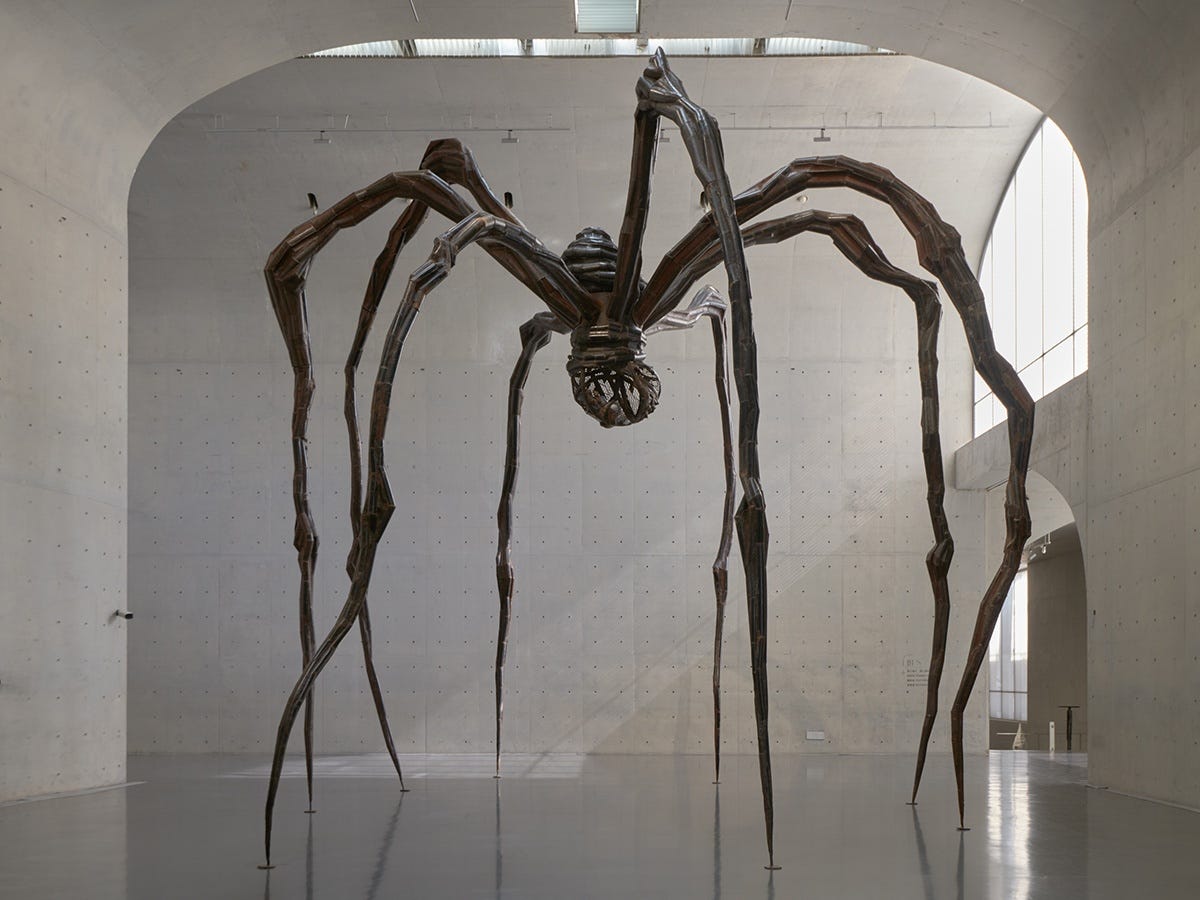
If Coraline and Star Wars had a sculptural baby, birthed by an Alexander Calder-Modigliani hybrid. But it’s none of those things; it is Maman by Louise Bourgeois. I first saw one of these (there are six total) at the Tate Modern in London when I was about ten years old; nine meters high, it both haunted and delighted me, staying etched in my brain and appearing in my dreams and nightmares for years afterwards.
Louise Bourgeois started making sculptures of spiders in the 1990s. This version is her biggest spider. Its title, Maman, is French for mummy. The artist said spiders reminded her of her mother: Like a spider, my mother was a weaver. My family was in the business of tapestry restoration, and my mother was in charge of the workshop. Like spiders, my mother was very clever … spiders are helpful and protective, just like my mother … The spider is a repairer. If you bash into the web of a spider, she doesn’t get mad. She weaves and repairs it.
One of six bronze casts of the original steel work also stands in an exterior plaza at the Guggenheim Bilbao in Spain. Editions of Maman can also be found in the collections of the National Gallery of Canada in Ottawa and the Crystal Bridges Museum of American Art in Bentonville, Arkansas (slay Arkansas).
Maman has held the record for most expensive sculptures by a woman three times in a row, and was sold for $32.1 million in 2019 (I only hate the art world because this shit is basically just money laundering and tax evasion, a hideous bastardisation of what art is and stands for, but here we are).
3. A Quote/Poem
“No male successfully measures up to patriarchal standards without engaging in an ongoing practice of self-betrayal.”
— bell hooks from The Will to Change: Men, Masculinity and Love (free pdf linked)
4. An Audio
God-tier flow-state type shit: Bobby McFerrin’s live performance of Sing! Day of Song, at Veltins Arena, Germany, 2010.
also
5. A Place
New York City (alternatives: London, Paris, Amsterdam, Florence, Athens, Barcelona)
Go out for a late late dinner, then spend the rest of the night walking around - stopping off whenever you feel inclined to do so - but mostly walking the streets of the city until the sun comes up. Do what you need to do to stay awake :) Preferably, watch the sun rise from behind the Brooklyn Bridge or an equivalent vantage point. Comfy shoes a must, water necessary. Alone (if so, and a woman, carry pepper spray, sigh) or in a group (no larger than 6). Get a bagel for breakfast, then sleep the day away if you’re a Sleep Princess like me, or soldier on and enjoy the subtly psychedelic effect of experiencing a day in a foreign city with zero shut-eye.
6. A Film
Wild At Heart, by David Lynch, 1990
Lynch stole my heart at sixteen when I first watched Twin Peaks. I am forever enamoured by the dreamy, surreal, sexy, silky-strange quality of his work. It soothes me. Wild At Heart was on my watch-list for years, and finally I got around to watching it - thanks to one of my more recent song fixations from Magdalena Bay (love), which mentions the film in the first few lines:
Anyway, the film follows Sailor Ripley (Nicolas Cage) and Lula Fortune (Laura Dern), a young couple who go on the run from Lula's domineering mother and the criminals she hires to kill Sailor. Laura Dern is unbelievably hot, as are their sex scenes. The music and outfits are completely fantastic. Everything is dreamy-strange-David-Lynch-for-real, and I’m in love.
Brilliant list, quotes from #1 are so powerful.
Shorter distance traveled, still I so relate to “all the different versions of oneself that exist within and in between those places.”
Obscure in the best way!!! Fab list